|
It's
no coincidence that the narrator of Douglas Coupland's novel
Microserfs lists one of his seven dream categories
in a game of Jeopardy! as being ' The history of Apple'.
No other company has aroused such interest, such passions,
and certainly I can't think of any other company that would
cause me to plough through a 584 page business tome in about
four days flat.
Having now garnered three popular books on everyone's favourite
dysfunctional corporate family, I think it's time to compare
their relative merits...
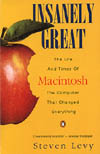 First
off, and in many ways still mt favourite, is Steven Levy's
Insanely Great. Doubt may now be cast of some of the
detail (more on that in a moment), but I have to say that
hardly matters. This is an incredibly good read, in fact easily
as gripping as Mr Coupland's excellent Microserfs.
It was written to mark the 10th anniversary of the Macintosh,
and only really covers the genesis and early history of that
machine, but the writing is so good as to be indispensible
for any Apple addict. First
off, and in many ways still mt favourite, is Steven Levy's
Insanely Great. Doubt may now be cast of some of the
detail (more on that in a moment), but I have to say that
hardly matters. This is an incredibly good read, in fact easily
as gripping as Mr Coupland's excellent Microserfs.
It was written to mark the 10th anniversary of the Macintosh,
and only really covers the genesis and early history of that
machine, but the writing is so good as to be indispensible
for any Apple addict.
Michael Malone criticises him for painting too rosy a picture,
but he does at least make it clear that Steve Jobs was utterly
anti-Mac until he realised that the Lisa would fail and then
he hijacked the project. Malone also complains that this book
lacks an index - which is slightly odd as my Penguin edition
seems to have one... Levy is not blind to the Mac's faults
either, and there's a great bit near the end where he looks
back to the typewriter age: "I never spent the whole
morning installing a new ribbon. Nor did I subscribe to RemingtonWorld
and IBM Selectric User. I did not attend the Smith-Corona
Expo twice a year..." Very funny, and very true.
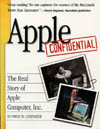 Formerly
the Mac Bathroon Reader, now re-hashed for some reason
as Apple Confidential, Owen W. Linzmayer's book is
a bit of a disappointment.
It's something of a cut-and-paste job, but it is at least
illustrated, unlike the other two book reviewed here - although
some of the illustrations, like the NeXT screen-shot, appear
twice. Nice to see photos of the Canon Cat, the Xerox Alto
and a Lisa screen-shot (although I'm still waiting for a Xerox
Alto screen shot from somewhere - this is the almost mythical
machine that supposedly inspired the Mac's WIMP interface,
and I would love to see just how similar they really are.) Formerly
the Mac Bathroon Reader, now re-hashed for some reason
as Apple Confidential, Owen W. Linzmayer's book is
a bit of a disappointment.
It's something of a cut-and-paste job, but it is at least
illustrated, unlike the other two book reviewed here - although
some of the illustrations, like the NeXT screen-shot, appear
twice. Nice to see photos of the Canon Cat, the Xerox Alto
and a Lisa screen-shot (although I'm still waiting for a Xerox
Alto screen shot from somewhere - this is the almost mythical
machine that supposedly inspired the Mac's WIMP interface,
and I would love to see just how similar they really are.)
It really should have kept its original title, as this is
a book for flicking through at random rather than reading
from start to finish - to do that is to drive yourself slightly
crazy. It's also full of graphs and 'timelines' that are next
to useless. Still, worth considering for the excellent trivia,
the pictures and odd insights I'd not heard about elsewhere
- like the fact that Apple turned down the chance to buy AOL,
the company that now owns Netscape and Time-Warner. Big bad
blunder indeed...
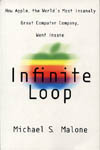 And
finally, Michael Malone's Infinite Loop: How Apple, the
World's most Insanely Great Computer Company, Went Insane.
A hefty tome, 584 pages with not one illustration. Admittedly
I was in the illest phase of chicken pox when I read most
of this, but it's a bloody depressing book. With the gift
of hindsight, Malone trashes, ridicules and generally pisses
on every single CEO Apple has ever had. I can imagine Spindler,
Amelio, Sculley et al turning up at Malone's house one day
to casually enquire, with the help of some baseball bats,
exactly what he would have done at the time. And
finally, Michael Malone's Infinite Loop: How Apple, the
World's most Insanely Great Computer Company, Went Insane.
A hefty tome, 584 pages with not one illustration. Admittedly
I was in the illest phase of chicken pox when I read most
of this, but it's a bloody depressing book. With the gift
of hindsight, Malone trashes, ridicules and generally pisses
on every single CEO Apple has ever had. I can imagine Spindler,
Amelio, Sculley et al turning up at Malone's house one day
to casually enquire, with the help of some baseball bats,
exactly what he would have done at the time.
Malone also has a habit of annoyingly contradicting himself
in the space of a few pages, as if an editor really needed
to re-check at least the early part of the book which details,
on the whole very well, the pre-IBM PC, pre-Mac world of personal
computing.
For a book that is so picky about getting facts right - chewing
out Robert X Cringely and others - it contains a fair few
mistakes that I spotted. For example, I'd always assumed DOS
stood for disk operating system, not digital operating
system, my iMac is Bondai blue, not Banzai blue, and
it also has a 56k modem even though it was bought on
launch day - Malone says the first iMacs only had a 33.6k
modem - so much for your trumpeted fact checker, Mr Malone!
Still, I can't deny this book is excellent value for money,
delving far deeper into the corporate shenaningans at Apple
Computer, and covering a far longer period than any other
book. The key shockers for me were his assertion that the
whole Jobs 'Road to Damascus'-style coversion on a visit to
Xerox Parc never happened, his duping of Woz over the Atari
money for Breakout and his initial refusal to accept paternity
of his daughter Lisa. I knew about the last two already, but
reading them again in such detail made me want to scream 'asshole!'
at Jobs if I ever met him. Which of course, I wouldn't. Oh
hello, Mr Jobs, I'm a huge fan, no really, I have all of your
computers, would you mind signing the base of my iMac keyboard,
it's not for me it's for my son...
If you have to pack one of these books for the beach, go with
Mr Levy's Insanely Great. It's the smallest, the happiest
and reads like a good novel.
|