Notes from Overground by Roger Green, was published in 1984 under the pen-name Tiresias. It is a lyrical, madenning, poetical, brilliant work about… about… commuting from Oxford to London. No, stick with me. He made the same journey every day, but unlike his fellow passengers, he had a notebook and he wrote down what he saw, heard and thought, riffing on the subject of commuting; “man is born free and everywhere is in trains”; “commuters of the world unite, you have nothing to lose but your trains!”. He wrote about places, made poems from their names, found literary connections to places and situations; he wrote about the slightly odd things most of us fail to notice or think much about. Goods wagons with fishy names. Cryptic signs – ‘Reading for engineers only’. Odd headlines – ‘Man Did Not Throw Brick’. Strange Tannoy announcements:
‘Will the Island Supervisor telephone the A.F.O.’ ‘Will the A.S.M. contact the A.M.O.’ ‘Will the B.V.M. telephone the I.H.S.’ ‘Will the I.C.B.M. intercept the U.F.O.’ ‘Will the P.M. report to the H.P. immediately.’ ‘Will the K.G.B. surrender to the S.I.S.’ Q: which of these announcements are not genuine? A: Try again. They are all genuine. Only the most hubristic commuter would deny having heard them all and many like them. Very probably the Last Trump will be heard over the tannoy at Paddington Station.
I loved it so much partly because I used to commute along a stretch of the same line, from Slough to Paddington (as part of my uber-commute from Windsor to Potters Bar) so I knew some of the landmarks and territory – not least the bizarre graffiti near Paddington that read ‘Far away is close at hand in images of elsewhere‘.
 The book threatened – not least according to its blurb – to become a cult classic, but I don’t think it ever did. Long out-of-print, it’s acquired almost mythical status to me over the years – my brother had borrowed it and it was in his briefcase when it was stolen. Amazingly the police recovered it and it was returned to me.
It’s almost twenty years since I travelled along that line, and a simple work trip to Slough and back was filled with queasy nostalgia and strange feelings about the passage of time.
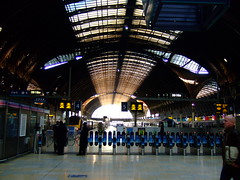 When I got to Paddington, I already felt like a time traveller. I could just about find the ticket office – it seemed to be more or less where I left it – but everything else seemed to have changed. The Lawn – the apron in front of the platforms – had become a high-tech shopping mall with neon escalators and Starbucks. The W H Smith I used to kill time in had shrunk and gone underground, as if hiding from the modern rubbish above. A 1984 that’s a far cry from the way it was in 1984:
On Friday nights when the hordes have gone home, when 1900 becomes 7pm, out ventures the British Rail Western Region Staff Military Band to exploit the superb acoustics of The Lawn. Lumps rise in throats, eyes blur as men (predominately) and women of all ages, with beer at their feet, produce their stirring, brazen stuff. Who are they? Booking clerks? Guards? Engine-drivers? Porters? Cleaners? I know not. But their music unites them, transforms them, welds them continuously into an entitiy which transcends BR and ASLEF and NUR and commuting, which makes nonsense of everything but this, where the whole consort momentarily dances together on a pin’s head.
Hard to imagine that being allowed today to interrupt commerce.
There were still trains that looked as if they were capable of high speeds, the exciting whiff of proper travel, decent distances – but no billboard proclaiming ‘HTV – your station back home’. Yes, and that was one of the reasons I turned my back on what lies beyond the ‘Bristol end’ of platform 1: Bristol.
Going to Slough I could either wait a while for a fast train that was going on to Evesham – where my BBC career began – or a slow train to Oxford – in the very train-tracks of Tiresias himself. The Oxford train was leaving now. From Platform 13, which is so far from the main concourse you almost need to get a train to reach it. Or I could go mad – go to Cornwall, go home to Bristol.
Platform 13 was irresistable. A mad dash and I was aboard and off.
Outbound journey was a failure – sitting on the left, facing south. Dazzling sun prevented me from taking any photos or indeed seeing very much. I was nursing a much-needed scalding hot cup of coffee, so I couldn’t really move. Resolved to sit on the left, facing north, going back so I could see more stuff.
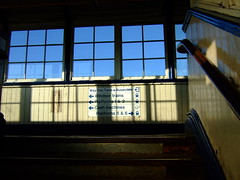 Climbing over the foot-bridge at Slough station, suddenly it seemed like very little had changed. I used to cross this bridge twice a day to get the train that shuttles between Slough and Windsor. Looking at the woodwork on the handrails and the walls, it could have been unchanged since the Second World War. The further you get from London, it seems, the slower time gets. Station Jim still stands proud collecting coins for the widows and orphans.
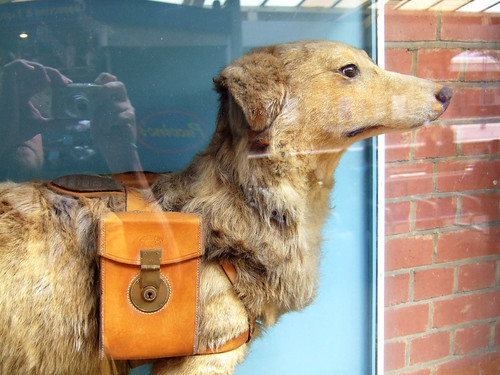
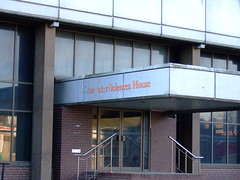 Right outside Slough station a high-tech office block from the 1980s was derelict and in decay. The sign has been vandalised and seemed to read ‘Commuter Sciences House’. I couldn’t help thinking that Tiresias, obsessed with commuting and the condition of the commuter, would have approved. I trudged off into Slough, trying to find an industrial estate; like looking in a haystack for – a piece of hay.
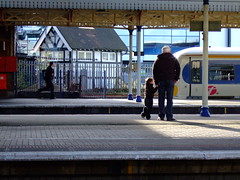 Work done; just missed a fast train back to Paddington, so I sat on Slough station eating my sandwiches and taking photos. A man waiting for a train with his grandson while someone runs for the Windsor shuttle; he’s probably running faster than the train he’s trying to catch will ever go.
Finally en-trained and off, I was facing North, the sun behind me; I started snapping and looking for familiar landmarks. I didn’t do too well. The closer to London I got, the more of a derelict industrial wasteland I seemed to move into. There was the odd building I recognised, a gas holder, a water tower…
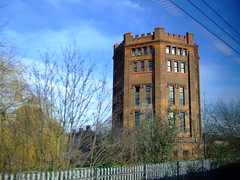 I used to dream of living in that tower – it seemed so big, so spacious, so many windows. Tattered curtains were hung at some of its windows, and I used to imagine some young poet or sculptor, surfacing very occasionally from the bed he shared with a succession of nubile young women, to knock off a minor masterpiece that would lie unappreciated until after his untimely death. The curtains are still there, but the poet in my head is gone. All I see now in that tower is a TV make-over show.
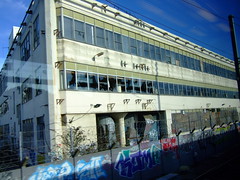 But where were the other landmarks? Where, for example, as I pulled out of Hayes and Harlington station, where is the mighty EMI? The Greatest Recording Organisation in the World. Well, how the mighty fall… my brother – he of the stolen briefcase – spotted it amongst my photos. Its windows broken, its walls sprayed with graffiti.
Back at Paddington I re-emerged into the other-wordly station; the ceiling as I walk out from Platform 11 seems to be made of huge, white cushions. The concourse was a confusion of people, people going in an unfathomable number of different directions; some commuters making short hops, some travelling the length of the British Isles, some having just got in from Heathrow, coming close to the end of journeys thousands of miles long.
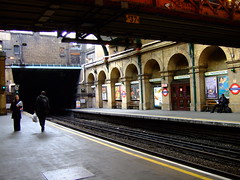 In the end Tiresias escaped – he escaped his job (his marriage?) and moved to Hydra to write poetry. At the end of my journey I decended into the underworld, the Circle line. Comfort, briefly as I headed back to work. When I started working at the BBC, I couldn’t sleep, except on trains. Tube trains were my pillows, my bedroom, my only rest.
The full photoset of the journey can be seen here.
 One of my favourite TV shows, Life on Mars, returns next week.