Winter holiday reading

winter holiday reading

A quick wintery ‘recently read’ roundup…

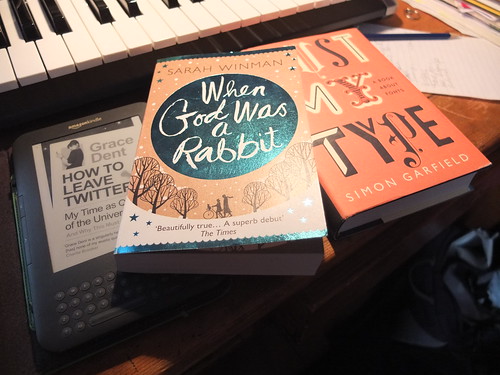
Just My Type by Simon Garfield.
My favourite of the bunch – an inspired Christmas present from @gwithiansunset. Apparently this was serialised on Radio 4, which is a bit odd for a book about the visual art of typography, and brings me to my only niggle with this lovely, fascinating, well-researched book: he often talks about fonts without showing you what they look like. I know I can look them up on the internet, but curled up in Cornwall with no internet access worth speaking of, it would have been nice to have them in print. But then I’m a font nerd. As a kid I used to fall asleep with the Letraset catalogue. It was my favourite book. So I’d like to have seen a full alphabet for every font mentioned – and perhaps a chapter on Herb Lubalin. But I’m being picky. A great book.

How to Leave Twitter by Grace Dent.
This was a Kindle 99p Christmas offer – in fact, as I type, this is still 99p on the Kindle. And I’m afraid I wouldn’t pay much more than that for it. It’s surprisingly sour, very short, but the chapter on Twitter stereotypes is very funny and horribly accurate. I can see myself in at least one of them. Her section on people who use tools to see who has unfollowed them is spot-on and exactly what I have always thought: isn’t there enough misery in the world already without going out of your way to find out who’s gone off you? And it made me think of my own reasons for unfollowing people:

  • Because you tweet too much.
  • Because you never tweet.
  • Because you said one thing, one thing out of a million tweets, that hurt me and I unfollowed you in a strop. I’ll be back.
  • Because, even though you follow me, you never reply to me when you solicit help or advice from Twitter at large, and frankly I now feel a bit like I’m stalking you, so I’ll just slink away.
  • Because you’re too happy and I’m in pit of despair just now. I know this is bad of me. I’ll be back.
  • Because you are having a massive argument with someone else I follow and it’s getting me down.
  • Because you are having way to much fun with someone else I follow and it’s getting me down.
  • Because someone thinks you’re flirting with me. You’re not, I know you’re not. If I know anything by now, I know when I am, and when I am not, being flirted with, but sometimes it’s simpler just to unfollow.
  • Because sometimes Twitter randomly unfollows people – I think this is deliberate and wonderfully good coding. It means you can blame any of the above on Twitter.

When God Was A Rabbit by Sarah Winman.
I wanted to like this book, I really did. It has a lovely cover, I found a signed copy in the bookshop in St Ives that was calling out ‘buy me’ as several people recommended it. And I did love the first half. The second half, not so much. It’s well-written, the childhood scenes especially, but too many things annoyed me – the historical events which, although they are dealt with sensitively, still felt crow-barred in to me, the utter absence of romantic love for the main protagonist, a couple of possibly accidental anachronisms: I don’t think you got gherkins in Wimpy burgers in the 1970s – I’m pretty sure they came in with McDonalds. And I’m pretty sure dads in the 1970s didn’t say ‘yay!’. In fact I’m not even sure anyone said ‘yay!’ in the 70s. And then the deliberate anachronism: the 50p piece with the date in the future that Jenny produces from her arm. I waited 324 pages for an explanation. It could have been mad, as crazy as a talking rabbit, I just wanted to know what it meant. And it was never referred to again. Maybe I’m just too thick to work it out.
Posted in Christmas, fiction, literature, recently read | Tagged , | 4 Comments

…which was nice.

In the dark days of winter it’s sometimes easy to lose sight of one’s achievements. This is just a personal list of things to remind myself that I’m not utterly useless or unlucky.

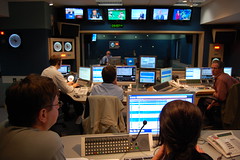
  • S39 – a new ‘flagship’ studio for World Service News & Current Affairs that I helped design, test and install. I wrote the instruction book for it, and I did my last ever World Service transmission as a Studio Manager in it. I love it. I feel towards it like the Doctor does to the TARDIS. I understand that the mixing desk will live on, in Scotland which makes me happy. I had been worried that it would be scrapped.
    New S39 1st TX
  • I wrote a book. Yes, it’s very short but I actually started and finished a book and some people seem to like it.
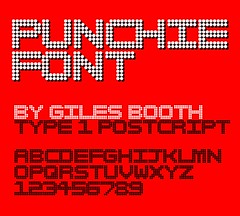
  • I designed a working font.
    Punchie font demo
  • I built a web site from scratch for someone using PHP and SQL that allowed them to upload their own audio showreel and edit the site on a web page. I have no idea how I did it, but I did.
  • Sometimes I take a photo I’m really happy with.
  • I invented a super-delicious recipe for pumpkin soup.
  • I got to spend a day in the Private Eye office on press day earlier this year, and I met Ian Hislop, Richard Ingrams and Tony Rushton. They were all lovely. Childhood dream come true.
  • I got to drive a small truck coast-to-coast across America in 2000, from Philadelphia to Los Angeles, part of the way on Historic Route 66. I got paid to do this.
  • I made an elegant dual-boot WindowsXP and Mac OS X netbook for under £300 – a lot of trial and error was involved in this, but it’s a wonderfully useful thing.
Posted in Grace in Small Things | Leave a comment

November spawned a monster

Or, My NaNoWriMo Hell

The creative processIt was a mad, spur-of-the-moment decision. I hadn’t thought it through. A couple of friends were doing NaNoWriMo – and I thought, what the hell, why not? 50,000 words in a month, 1666 words a day. Sure, I work full-time. Yes, I have three small children. But, really, How Hard Could It Be?

I already had two books on the go – one is about what happens to Patience Wilson, one of the characters in my previous book Constance Breakwater, when she grows up. The other is a mad idea, best described as The History Boys meets An Education via Doctor Who. NaNoWriMo demands a fresh work, though; you can’t import stuff you’ve already written, so I decided to have a crack at an immediate sequel to Constance Breakwater. I was going to knock something off, get it out on the Kindle by Christmas. Easy.

It started well. For the first three days I was either on days off or on late shifts at work and managed to find a couple of hours’ peace and quiet where I could write. I was hitting my targets. My word count graphs looked good. I smiled down with pity on my friends who weren’t quite on schedule to finish their books by the end of November.

Then I unexpectedly had a job interview to prepare for. All writing stopped. I very much wanted, and needed this job. I could not justify spending time writing when I really ought to be revising. Then I had a leaving do to go to: my own. The job interview and saying goodbye to the people and building I’d known for almost 21 years took 5 days out of my writing month. When I looked at the stats, they were grim. I had such a deficit to make up, I’d have to put in a 9,000 word day. NINE THOUSAND of the little fuckers in one, doubtless already packed, day. That simply wasn’t ever going to happen.

I started to hate the book I was trying to write. It was a stupid idea, going nowhere. I closed my NaNoWriMo account, thinking I could set my own, more realistic goals. 50,000 words in 2 months, perhaps. Or 6. Or a year.

Then one sleepless night I decided to abandon writing completely. I have a friend who’s had two novels published, but could not, no matter how many times he tried, get a third book published. Eventually he gave up trying. My own urge to write was, at the time, still so strong that I told him he was mad, but he said the relief when he decided he was no longer a writer was immense. And now I knew, a little bit, how he felt.

My first, short book came relatively easily. It had felt just like typing, admittedly after an awful lot of thinking and plotting in my head. And a lot of walking around Walton-on-the-Naze on my own. But it’s not like that any more. I do want to finish my two other books, but now writing is like banging your head against a brick wall. It’s lovely when you stop.

And I didn’t get the job.

Posted in children, family life, fiction, literature | Tagged , | 1 Comment

Circus Peanut Butter

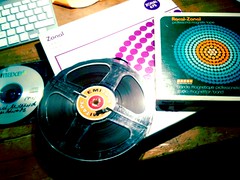
Locker tapesI’ve been clearing out my locker at work and found many iced gems on reel-to-reel audio tape. Perhaps oddest of all was a reel of American advert jingles from the 60s and 70s that I have no memory of – they must have belonged to my brother. I need to do more research on these, but a quick Google suggests some of them may have been written by Steve Karmen. I’d love to share them but as I clearly don’t own the copyright, I don’t see how I can.

I’m going to risk this one, though. It’s the oddest of the bunch by miles, and it’s for a long-dead brand of peanut butter. The lyrics and the music are just insane. I wonder why the brand died out…

Posted in food, media, music, nostalgia, radio | Tagged , , , , | 6 Comments

I Just Wasn’t Made for These Times

Ian Jack has written a very interesting piece about the death of newspapers – in The Guardian. Printed papers, he argues, are going to become a niche, luxury product like artisanal (awful word) cheese. I’d prefer to think of them as a luxury artisanal loaf – you can get cheaper, sliced bread in the supermarket, but it’s rather nice to be seen with some over-priced French bread under your arm. And it tastes better.

Ah, The Guardian. The Guardian drives me mad. I love it and I hate to love it and I love to hate it.

I grew up in a house where there weren’t many books but we devoured newspapers. My mum used to read The Daily Telegraph every day. In the 1970s it was a damn fine newspaper – it covered pretty much everything. Even Tony Benn said, I think in 1979 but it might have been 1983, that it was the only paper that had covered the general election fairly. Sundays meant the Sunday Express, when it was a broadsheet, and later, when I had some say in what we got, I’d devour all of The Observer and The Sunday Times every weekend. Each edition of The Sunday Times Magazine was an eagerly-awaited treasure trove of photography and reportage. I started reading The Guardian as a sixth former and kept with it through university days, gradually buying it less and less frequently as I grew older.

Now – I hardly ever buy a paper. We always used to get The Guardian on a Saturday, though – for The Guide, for Charlie Brooker’s scathingly hilarious TV reviews, for Jon Ronson’s column in the magazine, which I loved to hate. Now I hardly ever even read that.

I love my Kindle, and I tried subscribing to The Guardian on that. It was beautifully done, immaculately laid-out. Every morning a fresh paper was delivered automagically (I’m going to get in John Rentoul’s banned list if it kills me) to my bedside.

But here’s the rub: I could not, cannot, justify a tenner a month to read The Guardian on my Kindle when my wife, next to me, is reading all the same content, in colour, on the Guardian web site on her iPad – for free.

I tweeted my frustration – why oh why do The Guardian charge for the Kindle version when they are giving it all away for free on the web site? I couldn’t find any content on the Kindle that wasn’t freely available on the web.

I got a couple of responses – one from someone who used to to work for The Guardian who said “they need to make money badly, very badly that is, and are already committed to keeping the basic site free on principle.”

Well, that’s a noble principle, but it sounds like commercial suicide. I don’t like the Times paywall either, but at least they have a plan, and idea of how to make money – even if I only ever read it when Caitlin Moran tweets that the paywall is down, and I do a quick raid to read as many of her columns as I can before I get escorted off the premises by security.

More interesting were the comments I got from a current Guardian staffer who said “We also charge for the physical paper. Different platforms, different costs, different ad revenues – different business models” and replied to my question about why they charged for the Kindle version by saying “For design suited to the form? For offline reading? For a finish-able edition? To ensure we continue publishing?”

At first I got a bit annoyed by this – was he suggesting that I am killing the paper by leeching for free stories that they themselves put up for all to see on the web site? Then I thought a bit more about what he said, and his points are good ones: you do get the whole paper, as printed, and you can ‘read the paper’ from start to finish. But even when I bought the printed paper it was usually for particular writers – now Grace Dent and Charlie Brooker have tweeted links to their columns before the printed paper has hit the newsagents, and thanks to my iPhone, I am hardly ever offline.

The Guardian web site is great, the Kindle edition of the paper a wonderfully-executed thing – different costs, different business models… maybe they should make them the same, as as far as this consumer is concerned, there’s not so much difference between reading an article on a Kindle or an iPad.

The one odd thing about The Guardian on Kindle is that there are no adverts. I was reminded of American soldiers in Vietnam or Korea who were sent specially-printed editions of Life magazine with the adverts removed. They rebelled – they wanted the adverts as they perceived them as being part of the magazine. I’d be quite happy to have a free or subsidised Kindle Guardian with ads.

So that’s sorted. I just need The Guardian to give Caitlin Moran a job now.

Posted in media, newspapers | Tagged , , , , | Leave a comment