Review: Jeff in Venice, Death in Varanasi by Geoff Dyer

Caution: this review contains spoilers. This book is crap.


Jeff in Venice, Death in Varanasi
was recommended to me by an old school friend. (To be clear: the school is old. She isn’t). And I hated it. Awkward, as they say on Twitter.

It was, I thought, so to speak, not so much Uttar Pradesh as Utter Rubbish. I had such a strong allergic reaction to Geoff Dyer I had to get a friend staying in a nearby chalet to rush three Kate Atkinson novels over as an antidote.

To be fair to my school friend (she reads my blog – well, someone has to – hello!), she hadn’t finished it when she recommended it. And I actually really rather liked the first half. It was pretty funny. I liked the free sample on the Kindle – that thing he does, muttering thoughts almost out loud. I do that. My wife also says ‘you’re doing that thing again’. He must be just like me! I am going to like this book, I thought.

I’ve never been to Venice or the Biennale; in fact I’d never even heard of the Biennale until the last one. I saw a piece on the BBC Ten O’Clock News about it, and was horrified by what a self-indulgent junket it seemed to be. A call to a friend who works in the ‘Arts & Entertainment cluster’, or ‘nut cluster’, confirmed my suspicions, and the first section of Geoff in Venice rang true.

The problem starts at the half-way point. I sensed trouble was afoot as soon as we handbrake-turned into a new narrative voice. An amusing third-person tale of a loser journalist having an stupidly good time in Venice gives way to a first person account of a life falling to pieces in India amid mystics and illness and dope.

Half way through the second half, I got an uneasy sense that nothing at all was going to happen. Jeff’s new homespun religion reminded me of the sort of pseudo-mystical tosh an alcoholic (and now dead) colleague used to come out with – and other people’s drug experiences are about as interesting as other people’s dreams or yesterday’s weather forecast. Or yesterday’s dreams. Or other people’s weather.

I kept reading because I wanted to slag it off and thought I could only do that if I actually finished it, because I’d paid for it dammit (a tweep says that’s the latent Northerner in me) – and because I thought there might just be a sliver of a ghost of a chance of the one character you are expecting from the first half to re-appear, even if she only sails past on the Ganges, unseen, to, in some small way, tie the two halves of the book together. But no.

This book feels like a couple of bits of travel writing, or a slight novella and a really, really annoying bit of travel writing, stuck together. I don’t get it. Maybe it would help if I’d even read Death in Venice. Maybe I need to go to Venice and snort coke and go to Varanasi and smoke dope. I never wanted to do the latter, and I know for sure now that I never will.

It did, however, inspire me to write. Because I think I can do better. And I have my (old school) friend to thank for that.
Posted in fiction, literature, recently read | Tagged , , , | 1 Comment

The Guardian on the Kindle: Review

I’m just over a week into my 14 day free trial of The Guardian and The Observer on the Kindle, and here’s what I Reckon. I know there’s no reason why anyone should give a damn about what I Reckon, but I have lived with the thing for 8 days now, and it’s time to take stock.

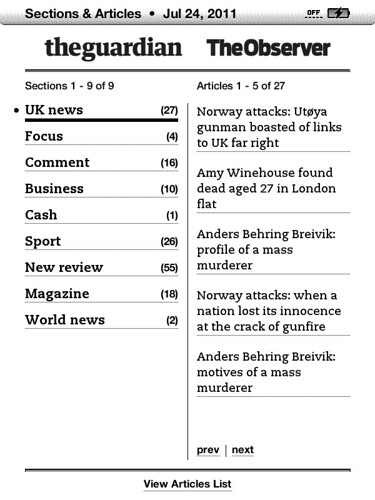
It is beautifully done – I had read very negative comments about The Times on the Kindle, and although I’ve not tried that paper, The Guardian seem to have done a much better job. You feel that the content has been properly reformatted for the e-book reader, there are no broken links or oddities that I’ve found. There are photographs which you can click on to see full-screen. I actually quite like looking at photos on the Kindle – black and white of course, but much better than a black and white newspaper photo. It’s not as richly-illustrated at the print version, however – for example I see from Twitter that today’s Observer profile of Louise Mensch has a cartoon, which is absent from the Kindle edition.
Guardian & Observer on Kindle
The convenience is good – I wake up and, as long as I left the wireless connection on, I find the day’s paper delivered freshly to my bedside table, ready for a quick browse in bed and then on the train. I love the Kindle reading experience – and the navigation of the paper in The Guardian’s implementation is as good as I think it could possibly be. You use the left & right 4-way buttons to skip articles, the page turn buttons navigate a page at a time. A link at the bottom takes you to the main menu at a single click. The built-in dictionary works too – not that I’ve found The Guardian taxing my vocabulary as much as some of the books I’ve read in the last year.

It feels very complete – I’ve not compared it directly with a print edition, but I get the sense that every word is there, if not every picture, including supplements like The Guide on Saturday and Observer Food Monthly.

I do like to clip out bits of paper, especially of reviews with lists of books and music I might enjoy – and you can do electronic ‘clippings’ on the Kindle, which get dumped in your clippings file on the Kindle itself. These lose all their formatting, though. For example, I clipped an article on Saturday where crime writers recommended their favourite books, and it’s just come out as one huge long stream of text, sub-heads and cross-heads all folded into one massively long paragraph – so working out who recommended which book is not easy. You can also tweet links to gobbets of text (as you can with books).

But then, there is the cost. £10 a month. Cheaper than the paper edition if you buy it every day – but I only ever used to buy The Guardian on Saturdays (mainly for the review, the glossy magazine and The Guide). And as far as I can see every word is available for free on their web site. So while I’m reading it on my Kindle, Mrs Wiki next to me is enjoying it in colour on her iPad – and for nothing. Not a penny.

So I’m cancelling my trial subscription today. I hate the Times paywall as much as anyone, but £10 a month is too much for something freely available elsewhere, even on the iPhone in my pocket. It’s one of those things like Spotify Mobile: if it were only a bit cheaper I might justify it to myself. A fiver a month feels about right. Sorry, Guardian on Kindle – we had a few laughs, I will miss you, but it’s not me, it’s you. It’s over.

Posted in internet, media, newspapers | Tagged , , | 4 Comments

Fantasy Celebrity MPs’ Question Time

You know what you have to do, Mr Speaker. You need to call all the following MPs to speak in one day, and we can have the bestest celebrity edition of Today (and Yesterday) in Parliament ever:

  • Richard Bacon, (Con) South Norfolk (contradiction in terms, South Norfolk?)
  • Gordon Banks, (Lab) Ochil and South Perthshire
  • Fiona Bruce, (Con) Congleton (the luckiest seat in England?)
  • Chris Evans, (Lab/Co-op) Islwyn
  • Dr Fox, (Con) North Somerset (it’s a rule of political reporting that you always have to refer to Liam Fox as ‘Dr Fox’ in the 2nd par)
  • David ‘Diddy’ Hamilton, (Lab) Midlothian
  • Chris Kelly, (Con) Dudley South (yes you do, used to present The Good Food Programme on BBC2.)
  • Robert Smith, (LD) West Aberdeenshire and Kincardine and member for The Cure.
  • Gareth Thomas, (Lab/Co-op) Harrow West – rugby player and Blake out of Blake’s 7.
Posted in Uncategorized | Tagged , , | Leave a comment

HUNGRY the STARS and EVERYTHING

There’s a tagline on the back jacket of Emma Jane Unsworth’s first novel that is out of place: ‘Can Mr Wrong ever be Mr Right?’. This makes it sound like chick-lit, and it’s at odds with the rather sophisticated under-designed cover, and at odds with the content. Hungry the Stars and Everything is a feast of a book – thoughtful, funny, maddening and very, very readable.

I don’t think I’m spoiling too much by saying that the devil pops up from time to time. I like to file my books thematically rather than artistically: Virginia Woolf nestles up against Katherine Mansfield as I imagine Woolf jealously hand-setting the type for Mansfield’s stories as therapy at the Hogarth Press. So Hungry the Stars… can go next to these two diabolical (that is to say, pertaining to the devil) books on my bookshelf.

The devil is just a bystander in this story, however. The real theme, clumsily rendered in the tagline, is the contrast between an unsuitable, dangerous former love and a present boyfriend who seems perfect – thoughtful, attentive, fantastic cook… and yet, and yet… something’s missing. As the book unfolds we find out more about how the central character, Helen, got to where she is now: sitting on her own, reviewing a swanky new restaurant in the centre of Manchester. The device Emma Jane Unsworth uses to reveal more and more about Helen’s past is so clever and brilliant I won’t say any more. You’ll just have to read it.

This is one of those books I enjoyed so much, when I got two chapters from the end I slowed right down; I couldn’t bear to finish it, and I couldn’t bear not to finish it, like the last thin square of some exquisitely bittersweet dark chocolate:

Children aren’t supposed to like dark chocolate. It’s one of those bitter things that you are meant to acquire a taste for later in life, like olives and self-pity. But I was different. I enjoyed the taste of wrongness in my mouth, the sheer devilment of what I was doing.

There was one, tiny thing that bugged me though. Now I’m a font nerd, and I love nothing more than a good ligature. Good ligatures these days are hard to find. But the ‘Th’ ligature in the font this book is set in is a bit oddly-shaped and quite ugly. I shuddered a bit every time one cropped up.

There. I said it was a tiny thing. This is a wonderful book.

Posted in fiction, literature, recently read | Tagged | 3 Comments

David Cameron: a metaphor

It struck me on the train this morning that the recent hospital photo opportunity where a camera crew got thrown out of a ward by a senior surgeon, is a metaphor for Cameron’s premiership thus far.

Dave goes along with some new enterprise without really stopping to think through the consequences. Angry mob (or man) intervenes. Dave says he agrees with angry mob, tells colleague to buzz off and rethink, and executes U-turn.

Just a thought.

Posted in media, TV | Tagged , | Leave a comment